
The Emotional Calculus of the Executive Interview

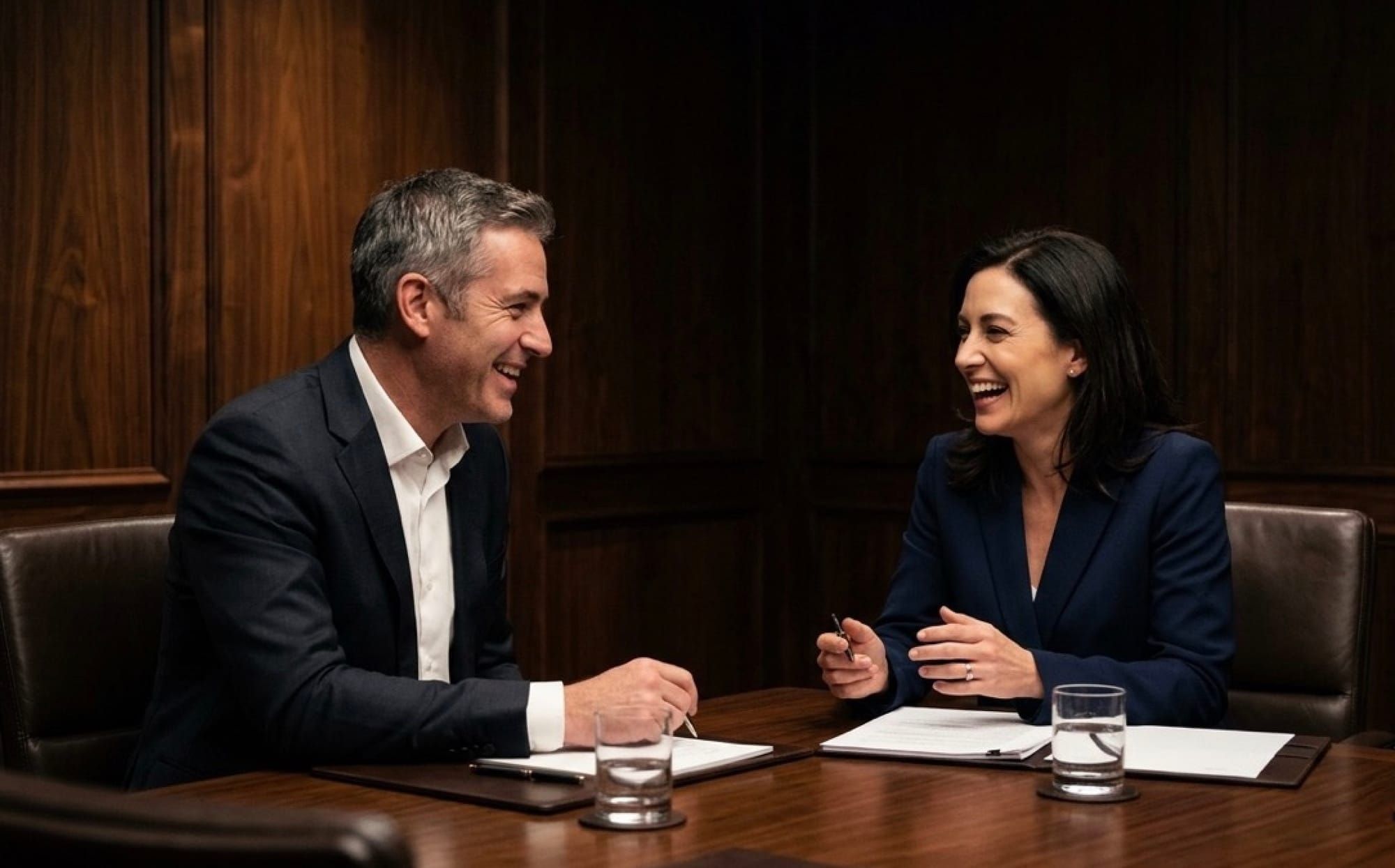
Why connection closes the offer gap that competence can't.
It’s the rejection email that haunts you.
It was unexpected. Shocking, actually. You were perfect. At least you thought you were.
You've worn the title three times. You've hired for it just as many. You nailed the technical answers, charmed the board, and left the room feeling beyond confident. Then this appeared in your feed.
We’ve decided to move in another direction.
This is not a misalignment. This is a realization: something has changed. The rules, the game, the process.
You pause for a moment.
You've been hiring for a long time now. You know how it works. In fact, you've been the one to actually change the rules when needed.
If you weren't so level-headed, this is the moment you might feel a scream building, fighting for release.
What went wrong? What was missed?
The part that gets skipped over isn't in the job description, isn't discussed in the pre- or post-interview brief, it's something that gets practically no air-time at all.
Sure, credentials, hard skills, functional competencies, and achievements are essential, especially as skill-based assessments take center stage. But these are usually used early on for consideration— getting picked for interview or used as early qualification that advances you to 2nd, maybe 3rd round. That's when those qualifiers are validated, no longer requiring debate. As someone who hires, you already know this.
The final decision is based on something different, more nuanced. Something most interviewers themselves rarely discuss. But its absence sounds like:
—Strong experience, the best we've seen. But just not the right fit.
—Solid qualifications. Cultural alignment is not quite there.
—You have really impressive achievements and qualifications. It was so close.
Throughout my career, I've worked to demystify this final interview, finish-line phenomenon. First recruiting consulting and value realization for Dell EMC. Then, executive leaders for people/HR and cyber at a Cisco acquisition. At Amazon AWS, hiring innovative technology builders and leaders for public sector customers including defense technology—revenue, pre- & post-sales, product, a long list.
Across the market, there is a gap in the hiring process between perfectly qualified and you'r hired. That offer gap is where your hard-earned offer slips out of reach.
You're reading...
Unhired.
The Unfiltered Reality of Modern Executive Search
The question nobody asks out loud.
To begin to understand the gap, start with the ultimate question that's actually behind every question in the hiring and interview process:
Can I trust you?
Can I trust you to exceed my expectations...to carry the organization through the next crisis...to represent my interests when I'm not in the room...to take us where we need to go next?
If you haven't built the right level of trust throughout the interview process, especially in that final rounds, the offer does not come. Yes, I can trust you is the only answer that unlocks the offer. Everything else leads to delay, another approval, an unexpected shift in the time line, a shift in another direction.
Can I trust you? is not a qualification question. To get to that answer requires a nuanced exploration. That's where rapport and connection take the center stage.
What rapport and connection actually are.
Rapport is not built with a scripted performance. It's not turned on with flip of a switch, or manufactured with a charm offensive.
Rapport is open dialogue and interaction that produces mutual understanding and respect. It requires work, focus and being fully present. It happens when you tune into the other person's priorities and unstated concerns, and adjust your approach — cues, signal, emphasis — to really see and hear them. It's:
Wow. They get it.
In The 7 Habits of Highly Effective People, Stephen Covey anchors this as one of his core principles– Seek first to understand, then to be understood. When interviewing, the tendency is to focus on getting our point across. Unless the interviewer understands your point's significance to them, that point is, well, pointless. Rapport shows understanding by practicing intentional listening and presenting ideas in a clear and articulate way that keeps the interviewer's perspective and priorities front and center.
Although different from 1:1 rapport, inspirational public leaders have honed this ability to connect and build rapport with people, at scale. They are our heroes, people we look up to and admire, writers, poets, even characters we identify with on our favorite shows. They make you feel like they're speaking directly to you, like they're somehow in your head, tuned into your situation.
The Distinction Between Alignment and Affinity
Rapport is built on understanding and being understood. It is driven by clear communication, using terminology and context that makes your expertise accessible. It’s important not to confuse this with affinity.
Affinity is the natural inclination to gravitate toward people who think, act, and look like us. Affinity bias occurs when an interviewer subconsciously uses that affinity or the gut feeling that it creates to determine role fitness or make a hiring decision. Using that feeling instead of qualification is misplaced and irrelevant to success in role.
Rapport, by contrast, is a core executive communication competency.
When you build rapport, your goal is alignment, not similarity. When you demonstrate that you understand their work and mission and respect their constraints, you show that you are the right person to select. This creates trust.
Building rapport, showing alignment, and creating connection are part of the core foundation that you share with the best speakers and communicators in the world.
Why rapport determines the executive hire.
Research from Harvard Business Review has been consistent about communications and hiring decisions for some time:
Hiring decisions are made emotionally and justified rationally.
Many other leading institutions agree, within the first few minutes of meeting, quite often within the first few seconds, the interviewer has made the decision, usually unconscious–whether they trust you and can picture you in the role. Then they use the rest of the interview to confirm or refute that assessment.
For executive leadership roles, the task also requires evaluating fitness to carry organizational risk. Will employees, clients, the board, and other executives trust you to lead through whatever crises the future holds? That binary comes down to:
Are you a safe bet -or- a calculated risk?
Even the slightest suggestion of risk can be disqualifying. It's not a coincidence this sounds similar to the trust rationalization. In both cases, emotional calculus rather than rational decision plays a part. While accomplishments are the critical consideration, they are supported by trust derived from building rapport and connection.
Rapport building itself is a data point and provides proof for how you'll build rapport if hired. Showing you listen well, read the moment, and adjust in real time demonstrate that you actually do what's required of a top leader. Missing rapport also raises a hiring objection practically impossible to overcome:
If you can't connect with me now, one-on-one in a controlled and friendly conversation, how will you connect with anyone else you're supposed to lead?
A safe-bet resembles someone who understands the mission, organization, and expectations of the role clearly and who represents its importance to the interviewer.
The Interviewer's Hidden Burden
For the interviewer, fit is also coupled with risk tolerance. The fit is the safe bet— someone who will lead without having to be led or managed; someone who's capable, who won't embarrass anyone in front of the board; someone who understands how to avoid political landmines without needing a guide or map.
Right or wrong, rapport is the signal used to assess the safe-bet fit. When a candidate doesn't build rapport and connect, like it or not, the signal reads high-risk instead of safe-bet fit.
The three interview phases to build rapport
Rapport is built systematically across three interview phases and provides a timeline in which to effectively work.
Phase 1: Before the interview
Interview preparation requires understanding each interviewer well enough to build rapport and make a connection.
Who are they?
Their bio, posts, LinkedIn profile, and published articles provide details to understand their perspective – who they are, what they do, what they believe, and what matters most to them.
It's a conversation, not a Q&A session
Executives who build rapport and connection approach the interview as a conversation rather than an audition or a performance. This establishes a healthy dynamic and an environment that supports asking difficult questions.
Interviewer-specific questions
Prepare at least two interviewer-specific questions that require personal insight only they can provide. If I join, we'd work together on some meaningful initiatives. What are some things you'd count on me to deliver?
What do they gain?
Identify and understand each interviewer's motivation. Why were they selected to qualify you? What do they gain if they select you? Put another way: What do you deliver that no other can deliver for that specific interviewer?
Phase 2: During the interview
Rapport is built through two-way dialogue, not monologue, audition, or presentation.
Pace your answers
Each leg of a story ideally lands in under 60 seconds. Pause between each leg and pulse for agreement. Ask a close ended, soft qualifier such as Is that your experience? or Is that consistent with what you see? or Would you agree? Then wait for agreement before continuing. Each acts as a micro-agreement forward. Address disagreement realtime before continuing.
While you're speaking, actively listen (including watch) the interviewer's reactions
The interviewer will show you precisely where they agree and where they don't. If they're not engaging, shift tone, tempo, or pause and redirect: I want to be sure I'm answering what you're really asking and are looking to understand. May we revisit the question?
Note their language
The exact words used are clues. What they hear, tune into, repeat back, or use to ask questions is direct, real-time feedback. Every detail is a data point worth exploring.
Use deliberate silence
When you finish speaking, stop talking. Silence signals confidence. The interviewer will fill the space, when appropriate, when they're ready.
Integrate what they gain
When you describe your future state in role, use their words. When they hear their own words and priorities echoed in your vision, they hear finally, someone who's listening, who has my back. This also creates a deeper connection and for some, the psychological safety required to an offer decision.
Considering the interview process, your time with each interviewer is a fraction of it and counted as the most valuable. Nothing is more important than understanding why you are the one they should choose. If it has to be said, say it—there is no such thing as being too clear. Think of this time as your only shot and do what's needed in the moment. Because actually, it is.
You're reading...
Unhired.
The Unfiltered Reality of Modern Executive Search
Phase 3: After the interview
The thank you note is more than a polite gesture. It marks the next round of rapport-building.
Timing
Send a thank you note within 24 hours or better, the same day. Timing signals gratitude and respect, not urgency. It solidifies the meeting memory while still fresh.
Content that lands
- Appreciation for their time and perspective
- An emotional reference to a positive or meaningful moment you shared
- A rational reference to something you bring that clearly resonated
- A question that encourages them to describe why they believe you're right fit.
- A thoughtful close such as As I carefully weigh my options, you're insight is valuable to me. Thank you for your continued help through the process.
Updates
A weekly update, not a check-in or follow-up, should paint a visual of you in the role, at your desk, in the Monday morning meeting. Add something you remembered. Share industry news relevant to something you discussed. Ask a question that doesn't require an answer but invites one. Reference something insightful they shared.
Another option is provide a timeline update: I promised to keep you informed. I've received an offer I'm seriously considering. I'd welcome your input as I make the decision.
What to avoid
Avoid language that reads needy, impatient, or entitled. Skip following up, checking in, looking for feedback, and any variant of when will you decide? No one is actively searching for an anxious leader.
To see how this framework transforms a candidate from strong qualifications resume to you're hired, let’s look at a recent engagement.
Case Study
How rapport changed the outcome
A client was moving from federal sector to commercial after leading several impactful innovation programs with government customers in financial services. She's a well-respected subject matter expert. In the last year, she'd interviewed more people than the rest of her career combined. She was confident and believed this interview experience was an asset, despite her inexperience interviewing as a candidate. In total, she'd been a candidate four times.
She reached the final round interviews with two different opportunities, almost simultaneously. She felt great about both, meeting and exceeding the requirements and qualifications beyond expectations. One role was a great fit, her public sector experience mirrored one of the companies.
Instead of offers, she received polite emails from both with practically identical versions of very strong background but not the right fit. She came to Persel Group seeking a solution. The InterviewEdge™ program provides a proven framework to improve interview outcomes - better, faster, more confidence.
We dug in.
She was an exceptionally qualified candidate. Large-team transformation experience. Education and organizations were top tier. She had the precise cross-functional expertise requested. Deep subject matter expertise and appeared highly technical and specialized. The credentials were tight.
In her exchanges, most of her answers were confident, thorough, and complete. This is great for a subject matter expert, a written assessment, and qualification evaluation. She treated each question like a scientist, providing structured, perfect answers, almost like one would provide on a test, trying to achieve a perfect score.
This approach works well for SME specificity. Otherwise, it can backfire. If the answer is more technical than the interviewer, you risk technical misunderstanding. A technical answer that is excessively confident can be read as non-negotiable. If the role goes beyond the SME, overly technical responses can trigger hesitation to hire, fearing a misalignment with non-technical staff, especially if the role requires translation.
Accuracy, detail, confidence, and the ability to synthesize technology are exceptional characteristics and skills, important and essential. Without the full picture and clear context, even the best characteristics can be mis-framed. Here's what we learned:
1) these positions including her target role are for leadership, requiring a lot of translation with non-technical staff, and with many non-technical business executives,
2) between the two declined positions, there were five final interviewers, all appearing to be well-experienced in industry, but like many senior executives, focused on business impact, not technical problem solving,
3) she leaned on technical expertise where she is most experienced, fluent and confident; she avoided leadership functions where she was less experienced; she is an exceptional leader, just not as experienced, and
4) she deprioritized rapport building and making connection in favor of technology.
Complete, detailed, and longer responses like the ones she provided are often self-contained meaning their completeness discourages follow-on dialog and questions. Without conversation, each interviewer never shifted into a conversation, and stayed in questioning mode. At the end of a long story or response with many details, many interviewers choose to move to the next question, for many different reasons. Instead of creating moments to dive deeper along the way, the conversation, along with deepening rapport and connection, got sidelined.
Leadership interviews, especially in the final stages, are meant for building rapport, connecting with each interviewer, building trust, and creating moments that practically feel what it's like to work together.
We crystalized a narrative that framed her experience to be aligned with her leadership focus. With that, fine-tuned her achievements to center around describing her impact as a leader to everyone, not just technologists. We focused interview preparation on articulation of her unique value propositions for each role, company, and individuals interviewing. We shifted mindset from detailed explanation to curiosity, understanding, and collaboration. We built confidence with practice and interview simulations, not memorization. Focus shifted from explaining to understanding what the interviewer was looking to know and delivering.
The most significant change was interaction: after every other answer, ask an unscripted question using something the interviewer said or referenced in that conversation, something relevant and unique to that moment; something that showed and further built understanding, rapport, connection, and trust.
The next few interviews were tough. By they third, she felt fluid and better connected. The forth ran over the scheduled time. The hiring leader followed up the next morning to continue their conversation. The offer came in shortly thereafter.
The bottom line
Rapport and connection are two deciding factors in interview decisions for leadership and executive hires, especially at the final stage. Both are built with discipline, actions, and behaviors throughout the interview process.
The executive who gets offers consistently invests the time and energy upfront to understand how they best-fit and uniquely deliver value. In each of the three phases, before, during, and after each interview, they integrate rapport building techniques that build connection. That connection helps ensure their unique value is clear and personal to each interviewer in the hiring decision.
Rapport and connection are not magic. They are skills that are developed with practice and iteration. They are essential to not only land offers but also open doors across every career.
Virtually no one is perfect at interviewing. Why? Because you don’t interview enough to even begin to achieve that status. Similarly, you wouldn’t walk into a critical board presentation or a merger negotiation without a rigorous dry run. Why treat what could be the most important meeting of your career any differently? Success in interviewing begins with understanding, and taking the time to understand the problem to be solved, the opportunity, the people involved, and most importantly, how you fit into this picture as the one made for this moment.
Join the community of executives who no longer leave offers to chance. Subscribe to Unhired.
Unhired.
The Unfiltered Reality of Modern Executive Search
Coming up:
The Emotional Calculus of the Executive Job Search— Why Connection Opens the Door Wider than Experience Alone
Post-Interview Steps that Keep You a Top Candidate—Ways to Keep Building Rapport for Future Opportunity
The Three Phases of Rapport—a Deeper Look at Landing Offers with Rapport
Learning to Speak Clearly without Your Voice—How to Communicate and Read Body Language
Executive Superpower—How to Sharpen Active Listening

Frequently Asked Questions. (FAQs)
How do you build chemistry with interviewers quickly?
Make them feel heard within the first few minutes. Ask one specific, researched question early. Listen closely to the answer. Then respond to what they actually said.
What are the strongest signs rapport is forming?
Follow-up questions from the interviewer. Personal disclosure. A conversation that runs over its scheduled time. Or the moment the interviewer starts selling you on the role.
Should behavioral stories be personalized to the interviewer?
Yes. Keep the facts consistent; shift the emphasis. A metrics-driven leader wants outcomes and scale. A people-focused leader wants team impact and culture.
How can executives avoid over-talking in interviews?
Build natural stop points into every answer. After about 60 seconds, pause and ask: “Does that address what you were asking, or would it help to go deeper?” That keeps the conversation interactive. It prevents monologue.
What if the interviewer seems cold or disengaged?
Acknowledge something they’ve said. Ask them to expand on it. A cold start can warm into a strong connection when the interviewer realizes you’re listening and responding to them specifically, not delivering a rehearsed set.
How is executive interview rapport different from other levels?
At the executive level, rapport itself is a performance signal. The interviewer is deciding if they trust your judgment, if they’d put you in front of their board, if you can build the relationships the role requires for the organization.
The InterviewEdge™ Program.
InterviewEdge™ is part of Persel Group’s Fulcrum Job Search Acceleration — preparation built with the connection that closes the offer, and more.